A question that often comes up is who should complete AML training within a firm or business.
This guide gives an overview of the staff training obligations, the relevant AUSTRAC guidance, and example tables that can help map training to roles in your business – one for legal professionals, one for real estate, one for accountants.
NOTE: The content on this website is general and is not legal, compliance or professional advice. Before you make a decision or take a particular action based on the content on this website, you should check its accuracy, completeness, currency and relevance for your purposes. You may wish to seek independent professional advice.
Identifying roles with AML/CTF duties
Law and conveyancing firms – example roles table
Real estate agencies – example roles table
Accounting practices – example roles table
Identifying roles with AML/CTF duties
Identifying roles with AML/CTF duties
Obligation at a glance
Reporting entities providing designated services must identify the roles in their business that are relevant to their AML/CTF obligations, and conduct personnel due diligence and training for the people performing those roles.1
‘Personnel’ is wider than just direct employees. It covers anyone the business employs or engages who has a role in its AML/CTF obligations – e.g. this could include contractors, consultants, interns, and people employed by service providers.2
AUSTRAC guidance
Mapping out who does what is the practical starting point. Until the roles are identified, there’s no way for a business to know who needs AML training (and what kind).
AUSTRAC’s Identifying personnel roles that require due diligence and training guidance sets out a suggested framework: list every role in the business that’s relevant to its AML/CTF obligations, then map the responsibilities each role performs.3
Personnel who perform functions relevant to AML/CTF obligations include people who:
- hold governance roles – e.g. the governing body, senior manager(s) and AML/CTF compliance officer
- have responsibilities under the AML/CTF program
- work in roles exposed to ML/TF risks
- perform any other roles that support or help perform the business’s AML/CTF obligations
The AUSTRAC guidance includes an example table that groups roles under the AML/CTF obligation they support – e.g. customer due diligence, ongoing CDD, suspicious matter reporting, threshold transaction reporting – to assist reporting entities in considering which people hold these roles in their own business. For example:
| AML/CTF obligation | Roles | Relevant personnel responsibilities |
|---|---|---|
| Customer due diligence (CDD) | Customer facing personnel Account or relationship managers Onboarding analysts | Interacts with customers or transactions Performs customer onboarding or identity verification |
Click here to view the full table on the AUSTRAC website.
High-risk roles
Once relevant roles are identified, AUSTRAC then expects high-risk roles to be flagged.4 These are roles that could pose a serious ML/TF or non-compliance risk if held by someone with inadequate skills or integrity. AUSTRAC’s guidance suggests considering whether a person can:
- design or influence changes to AML/CTF policies
- authorise investments, payments, or reports submitted to AUSTRAC
- override or bypass internal controls
- handle high-value transactions or physical currency
- approve or escalate high-risk customers
- amend customer risk profiles or related audit trails
- manage or authorise outsourcing arrangements
- access highly sensitive business or customer information.
Where any of these apply, AUSTRAC’s guidance flags the role as likely high-risk, which means more thorough personnel due diligence and tailored training to manage the associated risks.
Resources
| AUSTRAC program starter kits For the mapping work, AUSTRAC has released sector-specific personnel forms – an AML/CTF roles form and an Assign responsibilities form – as part of its starter kits for law firms, accounting practices, real estate agencies and conveyancers.5 The starter kits are designed for businesses meeting certain suitability criteria (broadly, smaller and simpler businesses), but may be useful as a starting template for larger, more complex businesses. | AML/CTF Roles Form – Legal Professionals Assigning Responsibilities Form – Legal Professionals AML/CTF Roles Form – Conveyancers Assigning Responsibilities Form – Conveyancers AML/CTF Roles Form – Accounting Assigning Responsibilities Form – Accounting AML/CTF Roles Form – Real Estate Assigning Responsibilities Form – Real Estate |
| Additional AUSTRAC guidance | Identifying personnel roles that require due diligence and training Examples of personnel due diligence and training in practice |
Providing AML/CTF training
Providing tailored training to roles with AML/CTF duties
Obligation at a glance
Reporting entities providing designated services must provide initial and ongoing AML/CTF training to personnel with AML/CTF responsibilities.6
The training must make sure staff understand:
- the business’s AML/CTF obligations under the Act and Rules,
- the ML/TF risks the business faces.
AUSTRAC expects training to be tailored to the person, their responsibilities, and the ML/TF risks relevant to their role. In other words, what each person is trained on depends on what they actually do.
AUSTRAC guidance (illustrated for your sector)
AUSTRAC’s AML/CTF training guidance includes an example training table that links AML/CTF functions to the training topics each function needs.7
The tables below pair AUSTRAC’s framework with examples of the typical roles that may perform each function in a law firm, an accounting practice or a real estate agency. Columns one and three are AUSTRAC’s. Column two is illustrative – the actual roles will vary depending on the nature, size and complexity of a business, and the roles and responsibilities assigned to staff under its AML/CTF policies.
Law and conveyancing firms – roles example table
| AML/CTF function | Illustrative roles | What training should cover |
|---|---|---|
| Initial customer due diligence (CDD) | Performs client onboarding, e.g. Junior lawyers/solicitors Legal executives Paralegals Support staff | How to follow your ID verification procedures How to conduct beneficial ownership, sanctions and politically exposed person checks How to conduct initial customer screening |
| Ongoing CDD | Dealing with or monitoring clients on an ongoing basis, e.g. Lawyers running matters Partners with ongoing client relationships Trust account staff | How to follow your ongoing CDD procedures How to collect and verify identity information and escalate unusual transactions and behaviour How to assess and respond to changes in customer risk throughout the business relationship |
| Enhanced CDD | Conducting enhanced CDD, e.g. The AML/CTF compliance officer Partners or principals approving high-risk engagements | How to tailor enhanced CDD measures to the customer risk Undertaking source of funds and wealth checks |
| Suspicious matter reporting (SMRs) | Any client-facing or transaction-facing personnel, e.g. Partners Lawyers/solicitors Legal executives Paralegals Operations Trust account staff Finance teams | Awareness of ML/TF risks of the business and suspicious indicators Identifying potential suspicious activity Your escalation procedures and timelines How to report accurately and on time |
| Threshold transaction reporting (TTRs) | Any role exposed to cash transactions, e.g. Trust account staff Finance teams Roles handling cash deposits or settlements involving physical currency | Understanding of threshold transactions What is structuring Who in your business reports TTRs Timeframes for submitting TTRs |
| Record keeping | Roles involved with creating or updating client records. e.g. Lawyers/solicitors Legal executives Paralegals File administrators Trust account staff Support staff | How to use any record-keeping tools Processes What records to keep Keeping accurate and complete records including of decisions made |
| Governance and oversight | The AML/CTF compliance officer, senior manager(s), and governing body, e.g. Partners as the governing body Managing Partner or CEO as senior manager The AML/CTF compliance officer | Deep understanding of specific AML/CTF obligations for each governance role Group structure (if applicable) Your ML/TF risk assessment and AML/CTF policies Good governance practice |
For more on AML training for lawyers, see our Tranche 2 page for law firms.
Real estate agencies – roles example table
Note: AML/CTF obligations for real estate agencies apply when a person is acting on behalf of buyers or sellers to arrange the sale, purchase, or transfer of property as part of a business. AML/CTF obligations generally will not apply to leasing or property management.
| AML/CTF function | Typical roles | What training should cover |
|---|---|---|
| Initial customer due diligence (CDD) | Performs client onboarding, e.g. Sales agents Sales support and admin | How to follow your ID verification procedures How to conduct beneficial ownership, sanctions and politically exposed person checks How to conduct initial customer screening |
| Ongoing CDD | Dealing with or monitoring clients on an ongoing basis, e.g. Sales agents Sales support and admin Trust account staff | How to follow your ongoing CDD procedures How to collect and verify identity information and escalate unusual transactions and behaviour How to assess and respond to changes in customer risk throughout the business relationship |
| Enhanced CDD | Conducting enhanced CDD, e.g. The AML/CTF compliance officer Licensee in charge of approving high-risk engagements | How to tailor enhanced CDD measures to the customer risk Undertaking source of funds and wealth checks |
| Suspicious matter reporting (SMRs) | Any client-facing or transaction-facing personnel, e.g. Sales agents Sales support and admin Reception Trust account staff Finance teams | Awareness of ML/TF risks of the business and suspicious indicators Identifying potential suspicious activity Your escalation procedures and timelines How to report accurately and on time |
| Threshold transaction reporting (TTRs) | Any role exposed to cash transactions, e.g. Trust account staff Finance teams Anyone handling deposits or settlements involving physical currency | Understanding of threshold transactions What is structuring Who in your business reports TTRs Timeframes for submitting TTRs |
| Record keeping | Roles involved with creating or updating client records. e.g. Sales agents Trust account staff Sales support and admin Office administrator | How to use any record-keeping tools Processes What records to keep Keeping accurate and complete records including of decisions made |
| Governance and oversight | The AML/CTF compliance officer, senior manager(s), and governing body, e.g. Business owner as the governing body Licensee in charge as senior manager The AML/CTF compliance officer | Deep understanding of specific AML/CTF obligations for each governance role Group structure (if applicable) Your ML/TF risk assessment and AML/CTF policies Good governance practice |
For more on AML training for real estate agents, see our Tranche 2 page for real estate.
Accounting practices – examples roles table
| AML/CTF function | Typical roles | What training should cover |
|---|---|---|
| Initial customer due diligence (CDD) | Performs client onboarding, e.g. Accountants and advisers Bookkeepers Client services teams | How to follow your ID verification procedures How to conduct beneficial ownership, sanctions and politically exposed person checks How to conduct initial customer screening |
| Ongoing CDD | Dealing with or monitoring clients on an ongoing basis, e.g. Accountants managing ongoing client relationships Client relationship managers Trust account staff | How to follow your ongoing CDD procedures How to collect and verify identity information and escalate unusual transactions and behaviour How to assess and respond to changes in customer risk throughout the business relationship |
| Enhanced CDD | Conducting enhanced CDD, e.g. The AML/CTF compliance officer Principal or partner in charge of approving high-risk engagements | How to tailor enhanced CDD measures to the customer risk Undertaking source of funds and wealth checks |
| Suspicious matter reporting (SMRs) | Any client-facing or transaction-facing personnel, e.g. Partners Accountants and advisers Bookkeepers Trust account staff Finance teams Client services teams | Awareness of ML/TF risks of the business and suspicious indicators Identifying potential suspicious activity Your escalation procedures and timelines How to report accurately and on time |
| Threshold transaction reporting (TTRs) | Any role exposed to cash transactions, e.g. Trust account staff Finance teams Anyone handling cash movements involving physical currency | Understanding of threshold transactions What is structuring Who in your business reports TTRs Timeframes for submitting TTRs |
| Record keeping | Roles involved with creating or updating client records. e.g. Office administrators Bookkeepers Trust account staff Client services teams | How to use any record-keeping tools Processes What records to keep Keeping accurate and complete records including of decisions made |
| Governance and oversight | The AML/CTF compliance officer, senior manager(s), and governing body, e.g. Practice owner as the governing body Senior leadership team member as senior manager The AML/CTF compliance officer | Deep understanding of specific AML/CTF obligations for each governance role Group structure (if applicable) Your ML/TF risk assessment and AML/CTF policies Good governance practice |
For more on AML training for accountants, see our Tranche 2 page for accounting practices.
Where Alpha AML Training comes in
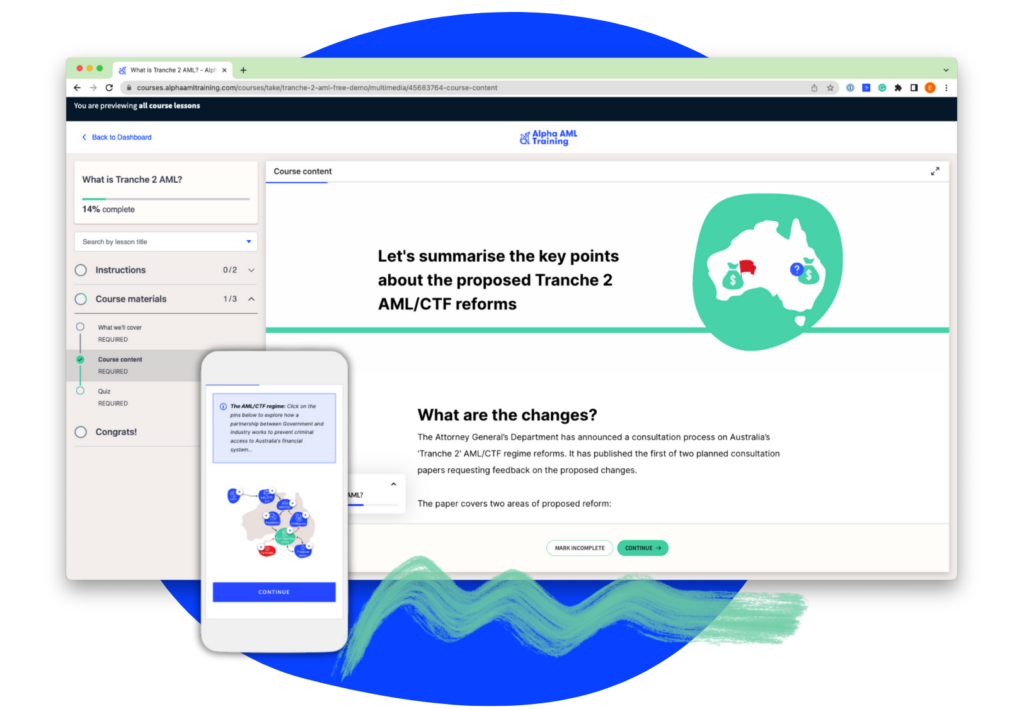
Once the mapping work is done, choosing training is the easy part.
Alpha AML Training’s five AML/CTF courses are built around the core functions in AUSTRAC’s guidance – so your team gets tailored training for the role they perform:
- Introduction to Tranche 2 AML – orientation to the new Tranche 2 regime
- Introduction to AML – general awareness for all roles that need the basics
- Red flags and reporting obligations – for personnel exposed to SMR and TTR triggers
- Customer due diligence – for roles performing initial, ongoing or enhanced CDD
- AML governance and AML/CTF programs – for the compliance officer, senior managers and governing body
Get started today
Book a free demo – speak with our team about training options, pricing and packages for your firm. Book a demo →
Or browse our full course library to find the right courses for your team’s training.
References
- Anti-Money Laundering and Counter-Terrorism Financing Act 2006 (Cth) , s 26F(4)(d) and (e); AML/CTF Rules 2025, ss 5-8 and 5-9.
- AUSTRAC, ‘Identifying personnel roles that require due diligence and training‘ (accessed April 2026), ‘Identifying relevant roles’.
- AUSTRAC, ‘Identifying personnel roles that require due diligence and training‘ (accessed April 2026), ‘Identifying relevant roles’.
- AUSTRAC, ‘Identifying personnel roles that require due diligence and training‘ (accessed April 2026), ‘Identifying high-risk roles’.
- AUSTRAC program starter kits, sector-specific ‘AML/CTF roles form’ and ‘Assign responsibilities form’ (January 2026). Available on the AUSTRAC website: ‘Program starter kits‘.
- Anti-Money Laundering and Counter-Terrorism Financing Act 2006 (Cth), s 26F(4)(e); AML/CTF Rules 2025, s 5-9.
- AUSTRAC, ‘AML/CTF training‘ (accessed April 2026), ‘Tailoring your AML/CTF training’.