Tranche 2 AML :
What
Your Business Needs To Know
A practical guide to the Tranche 2 reforms for real
estate agents, law firms and accountants. Learn what’s changing and how to prepare your business to meet new AML/CTF obligations from 1 July 2026.

What is Tranche 2?
“Tranche 2” refers to the expansion of Australia’s Anti-Money Laundering and Counter-Terrorism Financing (AML/CTF) regime to include additional industries.
From 1 July 2026, many law firms, accounting practices and real estate businesses will be required to enrol with AUSTRAC and comply with AML/CTF obligations under the AML/CTF Act and Rules.
Which business will need to comply?
From 1 July 2026

Real estate businesses including real estate agents, buyer’s agents, and property developers



Dealers in precious metals, stones and products
Will my business be regulated?
Use AUSTRAC’s ‘check if you’ll be regulated’ tool to confirm if your business will be captured under the Tranche 2 AML/CTF reforms.

Why are Australia’s AML laws expanding?
Australia is strengthening its AML/CTF framework to better protect the financial system and address
identified gaps. Key drivers of the Tranche 2 reforms include:

1
Regulating higher-risk professional services
Until now, services provided by real estate, legal and accounting professionals have largely sat outside the AML/CTF regime. This created vulnerabilities that criminals can exploit to move or conceal illicit funds. The reforms bring these higher-risk services into the AML/CTF system, closing those gaps.
2
Aligning with global standards
Most comparable economies already regulate these professions for AML/CTF risk. Australia’s delayed implementation has placed it behind international expectations and increased the risk of FATF scrutiny, including potential grey-listing, which could impact cross-border trade and investment.
3
Strengthening crime prevention
By expanding AUSTRAC supervision more sectors, Australia can better identify, detect and distrupt money laundering, terrorism financing and related criminal activitiy.
What will AML/CTF obligations mean for Tranche 2 businesses?
AUSTRAC’s Tranche 2 AML/CTF obligations outline the steps that newly regulated businesses will need to take to be ready for compliance by 1 July 2026:
Enrol with AUSTRAC
Businesses that provide one or more designated services must enroll with AUSTRAC and provide details about the business, its key personnel and the services it offers.
Develop an AML/CTF Program
Every regulated business will need an AML/CTF program that’s tailored to its specific risks.
An AML/CTF program has two core components:
- Risk Assessment
Identifies the money laundering, terrorism financing and proliferation financing (ML/TF/PF) risks faced by the business, and - AML/CTF Policies
The policies and procedures the business will put in place to manage those risks and meet AML/CTF obligations.
Appoint an AML/CTF Compliance Officer
Regulated businesses must appoint an AML/CTF Compliance Officer to oversee day-to-day compliance and act as the main point of contact with AUSTRAC.
The business must also ensure its AML/CTF Program is approved by senior management and overseen by its governing body (e.g. board), which must take reasonable steps to confirm the business is meeting its obligations.
In smaller businesses, these roles may all be performed by the same person.
Customer Due Diligence (CDD)
Regulated businesses must carry out initial and ongoing customer due diligence (CDD), as appropriate, based on customer risk.
Carrying out CDD involves documenting, collecting and verifying information to confirm a customer’s identity and assess the associated ML/TF/PF risks.
CDD procedures may be straightforward for individuals, but more complex when dealing with customers that are companies, trusts or other legal arrangements (as this may involve unwrapping complex entity ownership structures to identify beneficial owners).
If a customer’s ML/TF/PF risk is high, enhanced customer due diligence measures will be necessary.
Training staff
Regulated businesses need to ensure staff are trained so they understand:
- the AML/CTF obligations;
- the ML/TF/PF risks relevant to the business;
- business-specific policies and procedures and their role in carrying them out.
Ongoing training ensures that staff can recognise risks and apply the AML/CTF Program correctly.
Reporting to AUSTRAC
Regulated businesses will need to establish procedures to submit reports about certain transactions and suspicious matters to AUSTRAC. Reports that businesses need to submit include:
- Suspicious matter reports (SMRs)
- Threshold transaction reports (TTRs)
- Cross-border movement reports (CBM)
- Annual compliance reports
Keeping records
Regulated businesses must retain records related to their AML/CTF Program and compliance with the obligations. In most cases, records must be retained for 7 years. These include:
- The AML/CTF Program
- Customer due diligence information
- Transaction records
- Records of staff training
- Audit results
AML/CTF Reform Timeline: Key Dates
Every Business Needs to Know
31 March 2026
New AML/CTF obligations commence for existing reporting entities and Tranche 1 businesses.
March-July 2026
Key preparation window to train staff, build knowledge and ensure systems are used ahead of Tranche 2 AML/CTF obligations.
1 July 2026
AML/CTF obligations commence for Tranche 2 businesses and professions.
Penalties and why Tranche 2 compliance matters for Australian businesses
Tranche 2 compliance will soon be a legal requirement for businesses in sectors such as law, accounting and real estate.
Businesses that fail to meet AML/CTF obligations may face AUSTRAC enforcement action.
AUSTRAC has a range of enforcement options available and non-compliance may result in:
Civil penalty orders (court-ordered fines)
AUSTRAC may apply to the Federal Court for civil penalty orders where a business has breached its AML/CTF obligations. Penalties are measured in penalty units and, in serious cases, can amount to tens of millions of dollars.
Infringement notices (on the spot fines)
For certain contraventions, AUSTRAC may issue infringement notices. These are financial penalties that can be imposed without court proceedings. These have ranged recently from a few thousand dollars to hundreds of thousands of dollars.
Enforceable undertakings and remedial directions
An enforceable undertaking is a legally binding commitment to address compliance failures. AUSTRAC may also issue remedial directions requiring a business to take specific corrective actions. These outcomes may be made public.
Reputational damage
Enforcement action may attract significant public and media attention, potentially affecting client confidence and business relationships.
For businesses that must be registered (such as remittance service providers or digital currency exchanges), AUSTRAC may suspend, cancel or refuse to renew registration. Read more about AUSTRAC enforcement.
Staff training for Tranche 2 AML
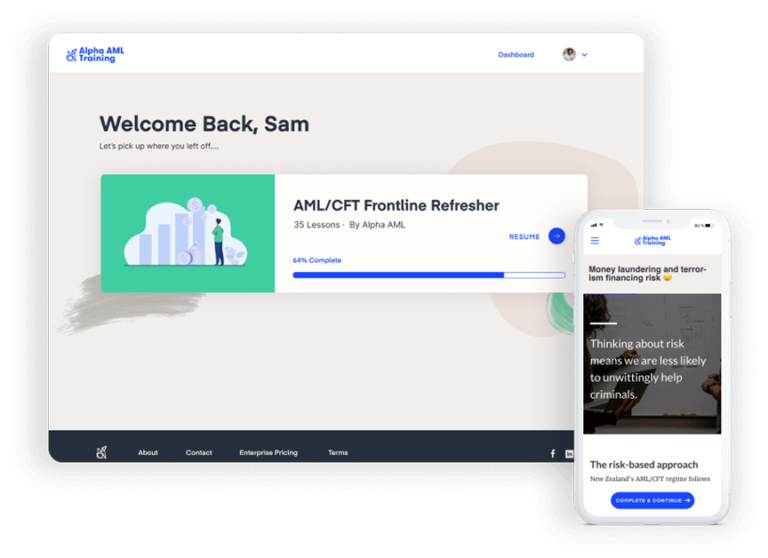
Alpha AML Training can help you prepare for Tranche 2 and make sense of your AML/CTF obligations with engaging staff training. Our online modules are designed for law firms, accountants and real estate businesses in Australia.
The platform gives businesses access to:
- Engaging AML training content
- Industry-tailored online courses
- Case studies to understand AML/CTF obligations
- Admin dashboard for easy user management
- Electronic training register
- Learner certificates
- 12- months of access
- Mobile and device-friendly
Get a head start today – equip your staff and build awareness of AML/CTF obligations before 1 July 2026.
Staff training for Tranche 2 AML
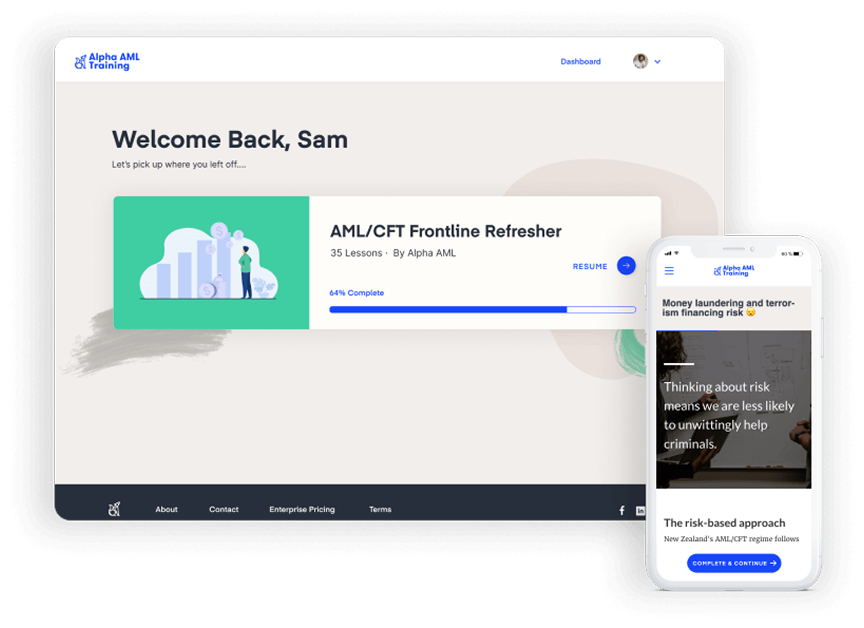
Alpha AML Training helps businesses prepare for Tranche 2 by building staff knowledge of AML/CTF obligations through engaging online training. Our modules have been designed for Australian law firms, accounting practices and real estate businesses.
Users of the platform get access to:
- Engaging online AML/CTF training
- Industry-tailored content
- Case studies to support understanding
- Admin dashboard for easy user management
- Storage of training records
- Learner completion certificates
- 12 months' access
- Mobile and device-friendly
Get a head start. Equip your staff and build AML/CTF awareness ahead of 1 July 2026, so your business is prepared to meet new compliance obligations.
Book a free demo today
Speak to one of our friendly team. Fill out the form and one of
our team will be in touch ASAP.