From 1 July 2026, anti-money laundering and counter-terrorism financing (AML/CTF) obligations apply to a much broader group of Australian businesses – the Tranche 2 professions. This guide walks through what those obligations look like in practice. It covers lawyers, conveyancers, accountants, real estate agencies, trust and company service providers, and dealers in precious metals, stones and products.
Note: The content on this website is general and is not legal, compliance or professional advice. Before you make a decision or take a particular action based on the content on this website, you should check its accuracy, completeness, currency and relevance for your purposes. You may wish to seek independent professional advice.
What’s in this guide:
- Are you in scope?
- Enrol with AUSTRAC (now open)
- Develop and maintain your AML/CTF program
- Carry out customer due diligence
- Report to AUSTRAC
- Keep records
- Train your personnel
Are you in scope?
Obligation at a glance. Tranche 2 captures certain professional services that have long been recognised as exposure points for money laundering. Specifically, the AML/CTF Act regulates businesses that provide a designated service with a geographical link to Australia – designated services are listed in section 6 of the AML/CTF Act. If you provide one or more of those services in the course of carrying on a business, you’re a reporting entity and the obligations in this guide will apply to you from 1 July 2026.
For Tranche 2, the new designated services are typically provided by the following businesses (newly regulated entities):
- real estate professionals
- lawyers
- conveyancers
- accountants
- trust and company service providers
- dealers in precious stones, metals and products
AUSTRAC guidance: AUSTRAC recommends two practical first steps: use AUSTRAC’s check if you’ll be regulated tool, and review the guidance on new industries and services to be regulated (see professional services designated services and real estate designated services). If you’re still unsure after that, AUSTRAC suggests independent professional advice.
Resources
| What it is | Resources |
|---|---|
| AUSTRAC tools and guidance to confirm status | AUSTRAC, ‘Check if you’ll be regulated’ tool AUSTRAC, ‘Professional services designated services’ AUSTRAC, ‘Real estate designated services’ |
Enrol with AUSTRAC
Obligation at a glance: The Act requires reporting entities to apply to be entered on the Reporting Entities Roll. When you enrol, you’ll need to provide details about your business structure, the services you provide, your key personnel
and your contact information.
AUSTRAC guidance. Enrolment is now open. AUSTRAC’s new enrolment forms went live on AUSTRAC Online on 31 March 2026, and the AML/CTF Obligations Factsheet for Tranche 2 Reporting Entities sets out the timing this way:
- enrol within 28 days of the day you start providing a designated service – for the new Tranche 2 services, that’s typically 29 July 2026
- keep enrolment details up to date – within 14 days of any change
- the due date for enrolment for new designated services is 29 July 2026
Once enrolled, you must keep your enrolment details up to date and notify AUSTRAC of any change within 14 days. Failing to enrol or keep details current is a civil penalty provision.
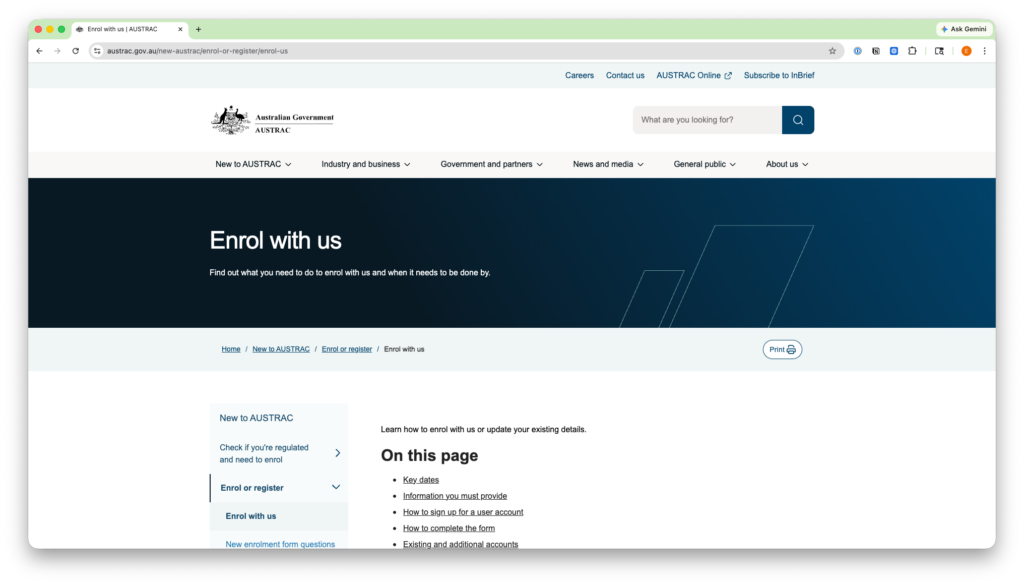
AUSTRAC enrolment is now open: AUSTRAC’s new enrolment forms went live on AUSTRAC Online on 31 March 2026.
AUSTRAC has published a preview of the new enrolment form questions if you’d like to see them ahead of time.
Resources
| What it is | Resources |
|---|---|
| AUSTRAC enrolment and supporting guidance | AUSTRAC, ‘Enrol with us’ AUSTRAC, ‘Preparing for our new enrolment forms’ AUSTRAC, ‘New enrolment form questions’ |
Develop and maintain your AML/CTF program
Obligation at a glance: Each reporting entity must have, and comply with, an AML/CTF program. Section 26F of the Act sets out what the program must contain, and the AML/CTF Rules 2025 prescribe further requirements. The program has two core elements:
- An ML/TF risk assessment – a money laundering, terrorism financing and proliferation financing risk assessment for your business
- AML/CTF policies – the procedures, systems and controls that you will use to manage and mitigate those risks and ensure your business complies with its AML/CTF obligations
Your AML/CTF program must be appropriate to your business’s nature, size and complexity, and kept up to date as your business and its risks change.
Governance and oversight of the AML/CTF program: The Act requires three governance roles – a governing body that oversees compliance at the highest level, one or more senior managers who approve the program, and an AML/CTF compliance officer (AMLCO) who runs day-to-day compliance and is the primary contact with AUSTRAC. In a small business, one person may hold all three of these roles.
AUSTRAC guidance: AUSTRAC has structured its AML/CTF program guidance into five steps (see the resources table below). AUSTRAC has also published sector-specific starter kits for Tranche 2 reporting entities – including legal, conveyancing, accounting and real estate professionals – which provide template documents to help small, low complexity businesses implement an AML/CTF program.
Resources
Customer due diligence
Obligation at a glance: Each reporting entity needs to complete customer due diligence (CDD) on its customers. Customer due diligence (CDD) is about knowing who your customers are and understanding any money laundering, terrorism financing, and proliferation financing risks associated with providing designated services to them.
AUSTRAC guidance: AUSTRAC’s Overview of customer due diligence describes the four practical layers:
Initial CDD
Before providing a designated service
- Collect and verify KYC information
- Identify the customer’s ML/TF risk
- Determine the CDD measures required for that customer
Ongoing CDD
Throughout the business relationship
- Keep KYC information current
- Monitor transactions and behaviour
- Reassess ML/TF risk over time
- Collect further information if needed
Risk-based variations
These can apply at initial CDD, ongoing CDD, or both.
Enhanced CDD
Required
Apply additional measures to identify the customer and to manage and mitigate ML/TF risks where:
- the customer’s ML/TF risk is high, or
- other circumstances specified in the Act or Rules apply (for example, dealing with a politically exposed person).
Simplified CDD
Permitted in defined circumstances
You may be able to apply simplified CDD for low-risk customers during initial and ongoing CDD.
Resources
| What it is | Resources |
|---|---|
| AUSTRAC customer due diligence guidance | AUSTRAC, ‘Overview of customer due diligence’ AUSTRAC, ‘Initial customer due diligence’ AUSTRAC, ‘Ongoing customer due diligence’ AUSTRAC, ‘Enhanced customer due diligence’ AUSTRAC, ‘Transitioning existing customers’ |
Report to AUSTRAC
Obligation at a glance: Each reporting entity needs to submit reports to AUSTRAC related to certain types of transactions and suspicious matters. These reports contribute to AUSTRAC intelligence that helps law enforcement detect potential criminal activity and keep the Australian community and financial system safe.
AUSTRAC guidance: AUSTRAC’s AML/CTF obligations factsheet for tranche 2 reporting entities summarises the reports that must be submitted to AUSTRAC:
| Report type | You must submit this report | Must be submitted within |
|---|---|---|
| Suspicious matter report (SMR) | When there are reasonable grounds to suspect a person isn’t who they claim to be, or that a matter is linked to criminal activity or proceeds of crime | 24 hours for terrorism financing; 3 business days otherwise |
| Threshold transaction report (TTR) | An individual transaction involves physical currency of A$10,000 or more (or foreign currency equivalent) | Within 10 business days after the day of the transaction |
| Cross-border movement report | Carrying, mailing or shipping physical currency or bearer negotiable instruments worth A$10,000 or more into or out of Australia | Before passing through customs (carrying); before sending (mailing or shipping); within 5 business days of receipt |
| Annual compliance report | Submitted by all reporting entities each year | Submission period will be 1 July – 30 September each year |
A note on legal professional privilege: there’s a separate process where the information forming the suspicion may be subject to legal professional privilege (LPP). AUSTRAC will instead require the submission of an LPP form in lieu of disclosing the privileged information (this form is currently being developed). For more information, see the resources table below.
Resources
Make and keep records
Obligation at a glance: You need to keep records of your activities and how you’re complying with your AML/CTF obligations. Most records need to be kept for seven years.
AUSTRAC guidance: AUSTRAC’s record keeping page outlines the records you must keep, including:
- AML/CTF program records
- customer due diligence (CDD) records
- transaction records related to a designated service.
How you store records is up to you – provided they’re legible, secure and easily retrievable. Because AML/CTF records often contain personal information about your customers, the Privacy Act 1988 and the Australian Privacy Principles apply alongside your AML/CTF obligations. The OAIC’s Privacy guidance for reporting entities under the Anti-Money Laundering and Counter-Terrorism Financing Act is a useful starting point for thinking about how to store these records.
Resources
| What it is | Resources |
|---|---|
| AUSTRAC record keeping guidance | AUSTRAC, ‘Record keeping overview’ AUSTRAC, ‘Record keeping checklist’ |
AML/CTF training
Obligation at a glance: Your AML/CTF program must include arrangements for personnel due diligence and training. Training has to be tailored to each person’s role and the ML/TF risks they’re exposed to – and provided both when they start and throughout their employment or engagement.
AUSTRAC guidance: AUSTRAC’s AML/CTF training guidance emphasises that training should be tailored to the role each person actually performs under the AML/CTF program. To help businesses think through what different training groups or roles within the business need, AUSTRAC has published an example role-by-obligation table. A couple of illustrative rows below:
| Obligation | Role includes | Training may cover |
|---|---|---|
| Initial CDD | Customer onboarding | How to follow your ID verification procedures; Beneficial ownership, sanctions and PEP checks; Initial customer screening |
| Suspicious matter reporting | Any role exposed to customers and transactions | Awareness of ML/TF risks and indicators; Escalation procedures and timelines; Reporting accurately and on time |
AUSTRAC Table – what training may include for personnel that conduct specific obligations. See AUSTRAC’s AML/CTF training page for the complete version.
Resources
| What it is | Resources |
|---|---|
| AUSTRAC training and personnel due diligence | AUSTRAC, ‘Personnel due diligence and training’ AUSTRAC, ‘AML/CTF training’ AUSTRAC, ‘Identifying personnel roles that require due diligence and training’ |
Train your team with Alpha AML Training
Alpha AML Training can help you meet your staff training obligations. Our industry-tailored AML/CTF training is built for Australia’s Tranche 2 sectors. Our e-learning modules are designed specifically for law firms, conveyancers, accounting practices and real estate agencies – reflecting the ML/TF risks and case studies that apply to your sector.
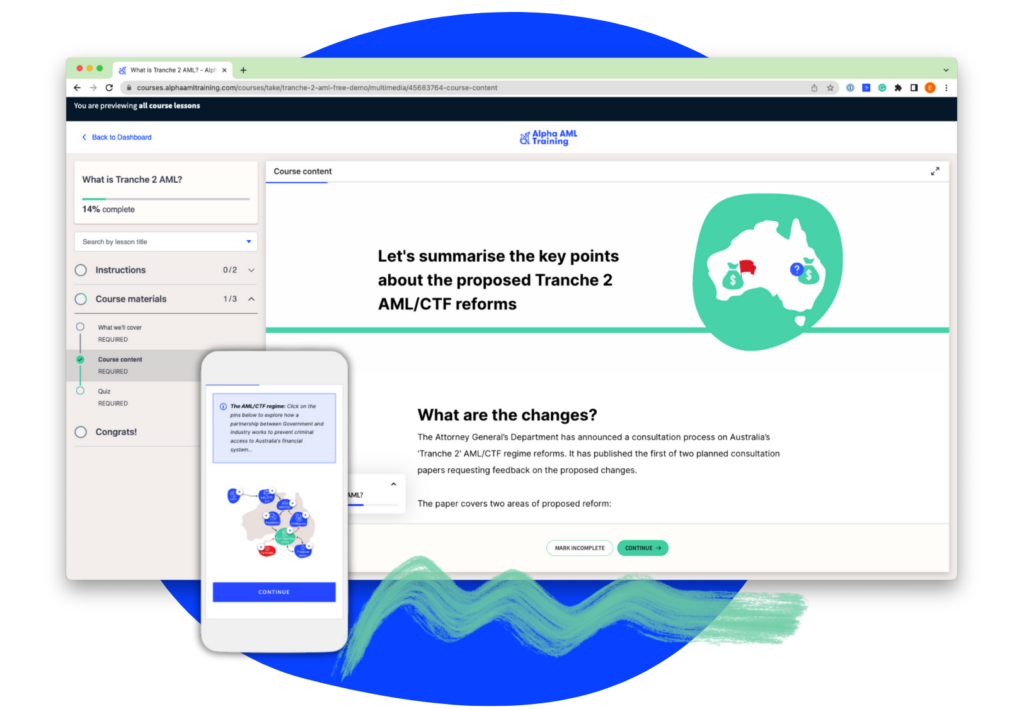
Alpha AML Training’s five AML/CTF courses are built around the core AML/CTF functions and aligned with AUSTRAC’s guidance, so each person gets tailored training topics aligned to the role they perform:
- Introduction to Tranche 2 AML – orientation to the new Tranche 2 regime
- Introduction to AML – general awareness for all roles that need the basics
- Red flags and reporting obligations – for client-facing personnel
- Customer due diligence – for staff involved with onboarding and CDD
- AML governance and AML/CTF programs – for the compliance officer, senior managers and governing body
Get started today
With 1 July 2026 approaching, now is the time to make sure your team is ready.
Book a free demo to talk through training options, pricing and packages for your firm – you could be delivering training to your staff today.